


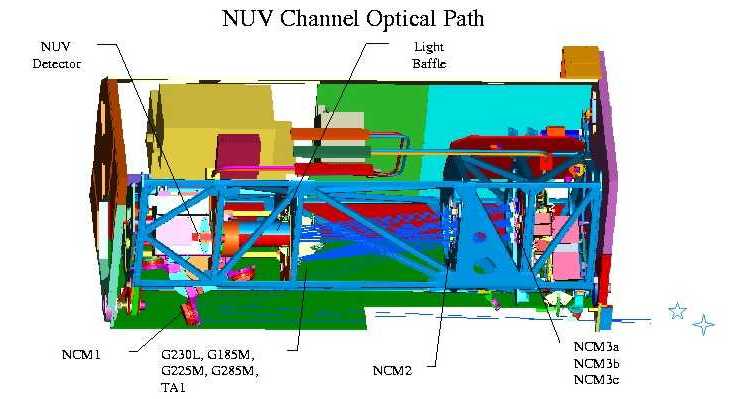
The COS NUV channel employs a Czerny-Turner design
(see Fig. 2).
This channel provides excellent sensitivity for moderate resolution
spectroscopy of faint UV targets in the 1700 - 3200 Å region.
It serves partially to back up the STIS NUV
spectroscopic modes and also will restore capability to observe faint
targets that has been mitigated by the high background of the STIS
NUV MAMA detector.
The COS NUV channel is fed by a mirror (called NCM1) on the optics
select mechanism 1. The beam is collimated by a second optic (NCM2)
and sent to the optics select mechanism 2 (OSM2) which contains
several flat, first-order gratings and a mirror used for imaging during
instrument test, on orbit alignment, and target acquisition.
Three medium-dispersion gratings (G185M, G225M, and
G285M) deliver resolutions R  16,000 over the wavelength range
1750 - 3200 Å. The dispersed light from the gratings is imaged onto
a CsTe MAMA detector by three camera optics (NCM3a,b,c). The
spectra appear as three non-contiguous
35-41 Å strips on the MAMA detector, allowing
105-123 Å wavelength coverage per exposure.
The gratings can be scanned to cover the entire NUV wavelength band.
A low-dispersion grating, G230L, delivers 400Å coverage per exposure
with a resolution of 1.2Å. A fifth optic on OSM2 is a flat
mirror (TA1) that images a few arcsec field of view. Because the
optics correct aberrations at a point rather than over a large field
(like STIS or ACS), unaberrated imaging is constrained to the central
arcsecond of the aperture.
The COS NUV spectroscopic modes are summarized in
Table 2.
16,000 over the wavelength range
1750 - 3200 Å. The dispersed light from the gratings is imaged onto
a CsTe MAMA detector by three camera optics (NCM3a,b,c). The
spectra appear as three non-contiguous
35-41 Å strips on the MAMA detector, allowing
105-123 Å wavelength coverage per exposure.
The gratings can be scanned to cover the entire NUV wavelength band.
A low-dispersion grating, G230L, delivers 400Å coverage per exposure
with a resolution of 1.2Å. A fifth optic on OSM2 is a flat
mirror (TA1) that images a few arcsec field of view. Because the
optics correct aberrations at a point rather than over a large field
(like STIS or ACS), unaberrated imaging is constrained to the central
arcsecond of the aperture.
The COS NUV spectroscopic modes are summarized in
Table 2.
| Grating | Wavelength Range | Coverage per Exposure | Dispersion (Å / pixel) | Resolving Power (
 ) ) |
| G185M | 1700 - 2100 Å | 3  35 Å
35 Å |
~0.0342 | 16,000 - 20,000 |
| G225M | 2100 - 2500 Å | 3
35 Å |
~0.0342 | 20,000 - 24,000 |
| G285M | 2500 - 3200 Å | 3
41 Å |
~0.0400 | 20,000 - 24,000 |
| G230L | 1700 - 3200 Å | 3 400 Å |
~0.3887 | 1550 - 2900 |
|