


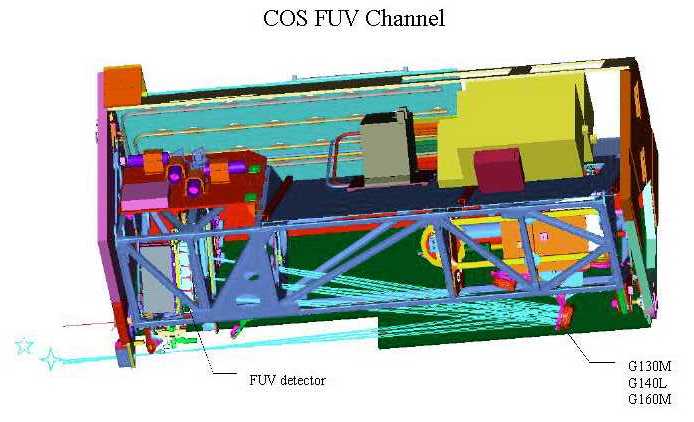
The COS FUV channel covers the wavelength range 1150 -
1775 Å. The FUV channel employs concave diffraction gratings and a curved
detector. It is fundamentally a Rowland spectrograph, modified to meet the
specific needs of HST. There is one reflection between
the aperture and the detector (see Fig. 1).
The gratings have aspheric concave surface figures specified to
compensate for spherical aberration. Holographically generated grooves provide
dispersion and correct the astigmatism. Ion-etching creates a blaze that
optimizes the grating efficiency over a narrow range of wavelengths. Two
gratings, G130M and G160M, are used to cover the range 1150 - 1775 Å
wavelength range at medium resolution (R = 20,000 - 24,000). Each
medium-dispersion grating covers roughly 300 Å in one exposure.
A third grating, G140L, covers the entire
1230 - 2050 Å region at lower resolution (R = 2500 - 3500). (The short
wavelength cut-off of the low-dispersion grating is designed to avoid bright
geocoronal Lyman  emission at 1216 Å.)
The three gratings are mounted on a rotating mechanism similar
in concept and function to the GHRS carrousel. The detector is a windowless
microchannel-plate (MCP) array, with an opaque CsI photocathode, and a
cross delay-line readout that has been adapted from the FUSE mission.
A fourth optic mounted on the optics select mechanism 1 (OSM1) feeds light to
the NUV channel. Table 1 summarizes the COS FUV spectroscopic modes.
emission at 1216 Å.)
The three gratings are mounted on a rotating mechanism similar
in concept and function to the GHRS carrousel. The detector is a windowless
microchannel-plate (MCP) array, with an opaque CsI photocathode, and a
cross delay-line readout that has been adapted from the FUSE mission.
A fourth optic mounted on the optics select mechanism 1 (OSM1) feeds light to
the NUV channel. Table 1 summarizes the COS FUV spectroscopic modes.
 |
 )
)