


Spectroscopy lies at the heart of astrophysical inference.
Our understanding of the origin and evolution of the cosmos
critically depends on our ability to make quantitative measurements
of physical parameters such as the total mass,
distribution, motions, temperatures, and composition of matter
in the Universe. Detailed information on all of these properties
can be gleaned from high-quality spectroscopic data.
For distant objects, some of these properties
(e.g., motions and composition) can only be measured through
spectroscopy. Ultraviolet spectroscopy, in particular,
provides some of the most fundamental diagnostic data
necessary for discerning the physical characteristics of planets, stars,
galaxies, and interstellar and intergalactic matter.
The UV offers access to Lyman  at low to moderate redshift,
high ionization stages of key diagnostic elements, and
unique abundance information for both atomic and molecular
species that cannot be obtained
at other wavelengths. Such data are essential to draw
a complete picture of the Universe.
at low to moderate redshift,
high ionization stages of key diagnostic elements, and
unique abundance information for both atomic and molecular
species that cannot be obtained
at other wavelengths. Such data are essential to draw
a complete picture of the Universe.
COS will build on the scientific legacies of Copernicus, IUE, GHRS, FOS, STIS, FUSE, and, in the future, GALEX, giving HST the greatest possible grasp of faint UV targets, a capability perhaps not available from future space-based observatories for decades. COS will complement and extend the suite of HST instruments, ensuring that Hubble maintains a powerful UV spectroscopic capability from 2003 until the end of its mission.
The science goals of the COS GTO team address problems of fundamental importance in astrophysics and cosmology which require the moderate resolution and high throughput of COS, and four unique capabilities of HST: access to ultraviolet wavelengths, large collecting area, precise pointing stability, and excellent image quality. Our study is organized into three broad categories, united by the theme of cosmic origins: (1) the origin of large-scale structure and the intergalactic medium (IGM); (2) the formation, evolution, and ages of galaxies; and (3) the origins of stellar and planetary systems.
 |
Models for the formation of large-scale structure and the reionization of
the IGM will be constrained by observing distant quasars to measure the He II
Gunn-Peterson effect, the structure of the Lyman
forest, and the
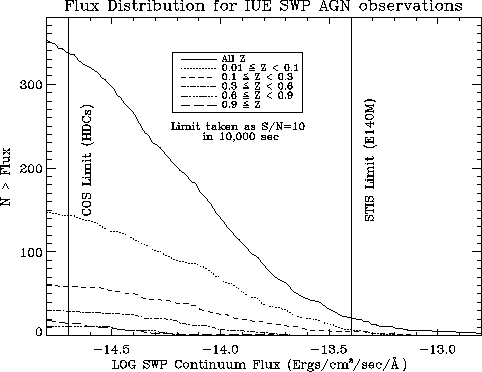
D/H ratio in primordial clouds. COS will be capable of obtaining
moderate-resolution UV spectra of hundreds more quasars and AGN than
existing UV instruments (Fig. 4).
The COS database of absorption-line systems
will have high enough spectral resolution and adequate S/N to determine
accurate column densities, abundances, and kinematics of intergalactic
matter at epochs when the first galaxies were formed and the first heavy
elements were synthesized.
We will use COS to
determine abundances and kinematics of hot gas in galaxy halos,
the impact of violent starbursts and supernovae on interstellar and
intergalactic environments, and the ages of globular clusters. The
numerous quasar sight-lines accessible to COS will intersect hot galaxy
halos over a large redshift range. COS spectra will constrain galaxy
evolution models by mapping the production of metal-enriched gas through
time. The large redshift coverage and high sensitivity provide access
to numerous diagnostic features, such as C IV
 1550,
O VI
1550,
O VI
 ,
and He II
,
and He II  304 in a variety of
high-redshift environments.
COS will also observe nearby starbursting systems over a range of
metallicity. These spectra will be used to model the chemical enrichment
of the interstellar medium, and as templates for deriving the properties
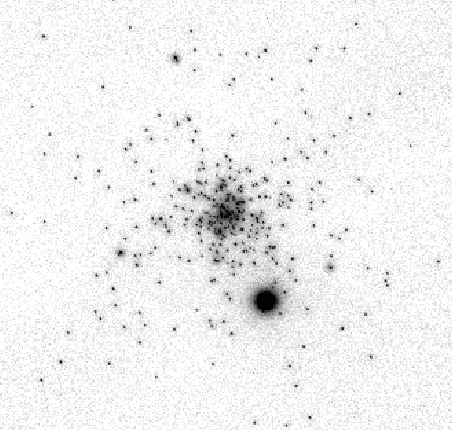
of high-z galaxies. COS UV spectra of horizontal-branch stars in globular
clusters (Fig. 5)
may allow significant refinement of globular cluster age
estimates, which can be used to reconcile the ages of the oldest stars
in galaxies with the age of the Universe derived from recent
measurements of the Hubble constant and closure parameter.
304 in a variety of
high-redshift environments.
COS will also observe nearby starbursting systems over a range of
metallicity. These spectra will be used to model the chemical enrichment
of the interstellar medium, and as templates for deriving the properties
of high-z galaxies. COS UV spectra of horizontal-branch stars in globular
clusters (Fig. 5)
may allow significant refinement of globular cluster age
estimates, which can be used to reconcile the ages of the oldest stars
in galaxies with the age of the Universe derived from recent
measurements of the Hubble constant and closure parameter.
 |
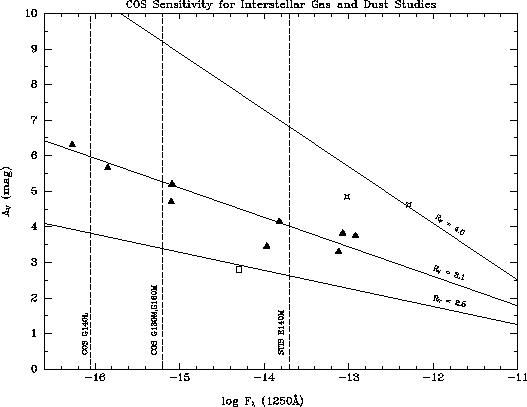
The origins of stellar and planetary systems will be investigated by studying the physical processes and chemical abundances in the cold ISM. For the first time in the UV, COS will observe sight-lines toward hot, embedded stars that will probe dense, molecular regions where the star formation process begins (Fig. 6). Resolution R = 20,000 UV spectroscopy with the COS high-dispersion modes will provide detailed information on gas-phase atomic and molecular abundances in the regime where the gas has become largely molecular and grain mantles begin to grow by direct deposition from the gas phase. These processes signify the earliest phases of collapse and accretion of stellar and planetary systems. Low-dispersion spectroscopy can be used to probe the UV extinction properties of the dust at high AV. We will also be able to search for structure in the UV extinction curve with unprecedented sensitivity, enabling us to determine whether the optical diffuse bands extend into the UV, and allowing us to search for specific features predicted to be formed by interstellar PAH molecules.
 |
The strengths of COS for faint object UV spectroscopy of point sources are by their nature more applicable to cosmology and certain Galactic observations than planetary science. However, the high sensitivity of COS does open up new spectroscopic investigations by HST within the Solar System. COS data will provide clues to the conditions and composition of the outer solar nebula. The high sensitivity of COS will allow an order of magnitude more background stars to be observed in stellar occultation studies of planetary and cometary atmospheres. COS will break new ground with direct moderate-resolution UV observations of Pluto and Triton that will be used to detect fluorescence emission from volatile gases as these bodies both undergo rare seasonal changes during the first decade of the next century.
Our scientific program attacks fundamental topics in astronomy and astrophysics. However, our GTO program represents just a small fraction of the total observing time with COS that is available to the world-wide astronomical community. COS is an extremely potent instrument for a broad range of science problems. Most of the science to be pursued with COS will actually be accomplished by the Guest Observer (GO) community, tackling a very wide range of projects that address many astrophysical problems. Such problems may include: AGN monitoring campaigns; UV upturn in elliptical galaxies; UV monitoring of distant supernovae; monitoring of SN1987A as it impacts its circumstellar material; stellar winds and UV properties of massive stars in the LMC and SMC; cataclysmic variables and other high-energy systems with accretion disks; line emission from heated plasma in accretion columns in young stellar objects; UV continuum measurements to determine SEDs and bolometric corrections in YSOs with accretion disks; chromospheric emission from cool stars and the evolution of magnetospheric activity in young stars; planetary aurorae; emission characteristics of cometary comae; studies of diffuse objects where the goal is to reach the deepest possible UV flux levels, for example, detecting high-ionization (e.g., C IV) emission from the Milky Way halo, the outer blast wave of the Crab nebula, or shock waves in supernova remnants and Herbig-Haro jets.
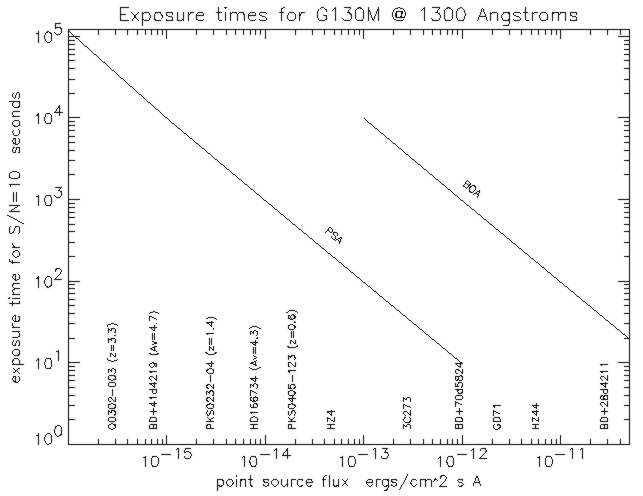
Our investigation requires observations of very faint targets, taking full advantage of HST capabilities (large aperture, UV coatings, excellent pointing, and image quality). COS is optimized to observe faint UV sources (Fig. 7) with spectral resolution high enough to determine the physical conditions in a broad range of astrophysical environments. Its design meets programmatic requirements for reliability and redundancy, and its simplicity and efficient operation ensure a high science return. With these capabilities, we anticipate a high degree of interest in using COS throughout the world-wide astronomical community.
 |
 =1620 Å)
obtained by the Ultraviolet Imaging Telescope (UIT).
The 20-arcmin field of view shown encompasses nearly the entire cluster.
Although NGC 6752 contains more than 105 stars, nearly all of these stars
are too cool to emit any UV light. The 330 stars seen in this UIT image
are all HB stars, except for the over-exposed bright star 4' southwest
of the cluster center, which is a foreground star. COS will provide
follow-up spectroscopy of targets identified by UV imaging telescopes.
From
=1620 Å)
obtained by the Ultraviolet Imaging Telescope (UIT).
The 20-arcmin field of view shown encompasses nearly the entire cluster.
Although NGC 6752 contains more than 105 stars, nearly all of these stars
are too cool to emit any UV light. The 330 stars seen in this UIT image
are all HB stars, except for the over-exposed bright star 4' southwest
of the cluster center, which is a foreground star. COS will provide
follow-up spectroscopy of targets identified by UV imaging telescopes.
From  20,000
resolution COS G130M FUV grating, assuming
the 2.5'' Primary Science Aperture is used. Example targets
are noted along the horizontal axis above their corresponding UV fluxes.
Exposure time estimates through the Bright Object Aperture
are presented for bright fluxes at the right region of the plot.
20,000
resolution COS G130M FUV grating, assuming
the 2.5'' Primary Science Aperture is used. Example targets
are noted along the horizontal axis above their corresponding UV fluxes.
Exposure time estimates through the Bright Object Aperture
are presented for bright fluxes at the right region of the plot.